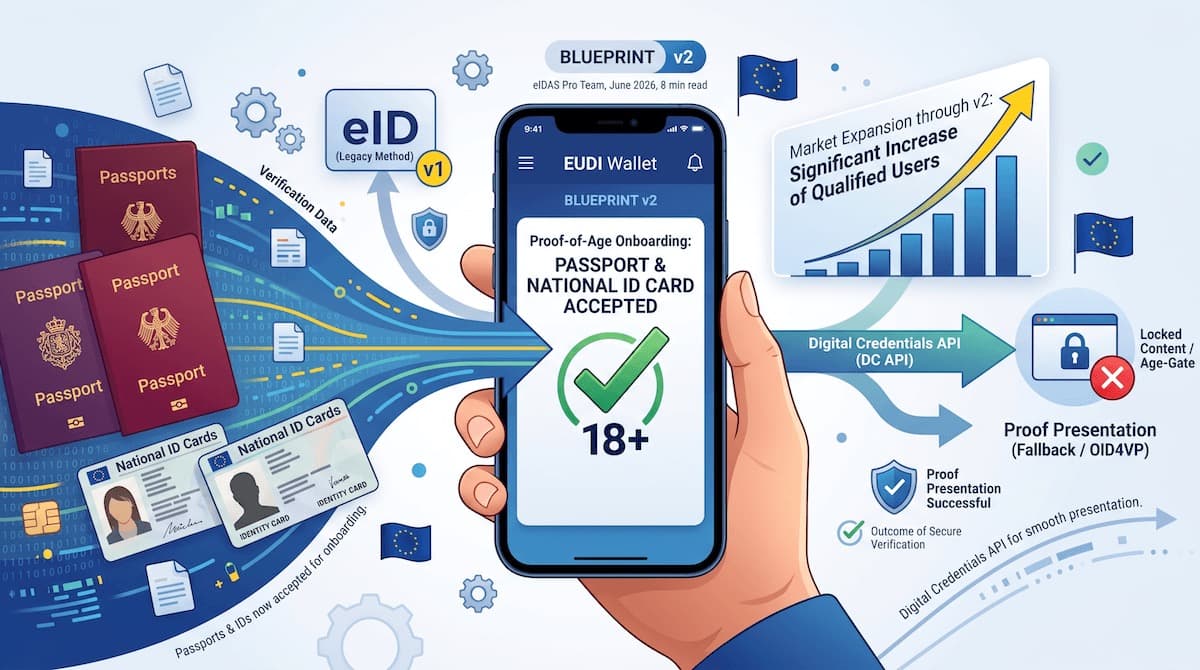
The headlines around the EU age-verification blueprint have fixated on dates: published July 2025, feature-ready April 2026. The more consequential change came in between, on 10 October 2025, when the Commission released the second version of the blueprint. It added two capabilities that read like footnotes and behave like market expansions: passport and national ID-card onboarding, and support for the Digital Credentials API.
If your business model depends on how many people can actually obtain — and present — a proof of age, v2 is the release that mattered.
The onboarding bottleneck v1 had
To get a Proof-of-Age attestation, a user has to prove their age once, to a trusted source, during onboarding. In blueprint v1, that trusted source was an eID — a national electronic identity. That is a clean design, but it carries an uncomfortable dependency: it assumes the user has an activated eID.
That assumption does not hold uniformly across the EU. Plenty of citizens in plenty of Member States either lack an activated eID or have never used one — a gap visible in adoption data we covered in the Bitkom awareness survey, where awareness and activation of digital identity lag behind interest. An age-verification solution that can only onboard eID holders is, in practice, an age-verification solution for the digitally-onboarded minority.
What v2 changed
Version 2 added passports and national identity cards as onboarding methods, in addition to eIDs. The significance is reach:
- Passports are held far more widely than activated eIDs, and they contain a chip (the ICAO eMRTD) that can be read to establish identity and date of birth to a high assurance level.
- National ID cards similarly extend onboarding to people who have the physical document but never activated an online eID.
The result is a much larger pool of people who can obtain a proof of age without first having to climb the eID activation hill. For any relying party whose conversion funnel currently leaks at "I don't have that set up," this is the change that plugs the leak.
The second addition: the Digital Credentials API
V2 also introduced support for the Digital Credentials API (DC API) as a presentation method — a browser- and OS-integrated way for a verifier to request a credential and the wallet to respond, increasingly available in modern operating systems and browsers.
Where onboarding via passport widens who can get a proof, the DC API improves how smoothly they present one. It is the higher-UX path in the verifier's runtime fallback matrix, with OpenID4VP remaining as the fallback for browsers that lack it. The two v2 additions therefore attack the funnel from both ends: more people qualified to hold a proof, and a smoother moment of presenting it.
Why this is a market story, not just a feature note
Put the two additions together and the strategic picture is clear. The total addressable population for EU age verification is bounded by two numbers: how many people can obtain a proof, and how friction-free it is to use one. V1 constrained both — eID-only onboarding capped the first, and pre-DC-API presentation flows taxed the second. V2 lifted both caps in a single release.
For a relying party, that changes the calculus on when to adopt. If you assumed the EU solution was only viable for the eID-mature states, v2 is your signal to reassess: the onboarding base is now much broader, which means the share of your users who can actually clear an EU-standard age gate is materially higher than it was under v1.
And because the "mini wallet" is built on the same technical specifications as the EUDI Wallets — interoperable by design and open source — adopting it now is not a throwaway. It is a stepping stone toward full wallet acceptance: the integration you build for proof-of-age today is the foundation you extend to richer attributes as the wallets roll out before the end of 2026.
What to do with this
| If you are… | v2 implication |
|---|---|
| A platform under DSA Article 28 | A larger share of your users can now clear an EU-standard age gate — the coverage objection to adopting it is weaker |
| A merchant in a low-eID-activation market | Passport/ID onboarding means the solution is viable for your users even before national eID uptake catches up |
| A developer | Plan for DC API as the primary presentation path, OpenID4VP as fallback — see the fallback matrix |
| Watching the rollout | The broader onboarding base raises the stakes of the end-2026 availability target |
The bottom line
Blueprint v2 will be remembered, if it is remembered at all, as the "passport onboarding" release. That undersells it. By letting people onboard with documents they already hold and present with an API their browser already speaks, v2 widened both ends of the age-verification funnel at once. The privacy model did not change — proofs remain threshold-only, one-time-use, and batch-issued — but the number of people who can participate did. For anyone whose case for adopting the EU solution rested on "not enough of my users can use it," that case got materially weaker in October 2025.
This post reflects the EU age-verification blueprint as of version 2 (10 October 2025) and the ecosystem position as of June 2026. Verify against the official Commission announcement before relying on specifics.
Share this article
Help others learn about eIDAS verification